
A new beginning…
It has been nearly seven years since Roger passed away and we have been diligently trying to keep his legacy alive by continuing to sell tubes, equipment, and perform service work. Roger’s education initiative also persisted although not through the Berkeley Hi-Fi School. Instead, we created Roger’s Corner here on the site and digitized a lot of content making it accessible to all who desire to learn from one of the best minds in the industry. Roger’s vision for the RM-10 MkIII amplifier came to life as well. No small task especially as we had to navigate through COVID for a portion of the project.
It is one thing to try and keep a business alive but another thing altogether to try and keep someone’s legacy alive. Continuing to evolve and making the best of the situation was all we could do and it was a crowning achievement when we started selling MkIII kits with one builder exhibiting his MkIII at an audio show in Las Vegas. If Roger were alive, he would have been extremely proud, heck he would have flown to Las Vegas to be there in person.
Speaking of evolving, at the beginning of this year I received my Italian citizenship and so I made the decision to retire for good. That decision led to me to reflect quite a bit on what I wanted to do with the rest of my life. I recalled when my friend Gino closed his restaurant several years ago and retired. For a retirement gift I took him back to Napoli, his place of birth, to visit his family and friends there, many of whom he had not seen in a generation. Funny thing though, I only got him a one way ticket. As he had worked pretty much non-stop for 50 years, I told my friend to take this opportunity to stay in Italy a while and enjoy retirement. He never came back and is living his best life now.
So now I feel this is the time to make some changes so that I can take the next step in life. With that comes some difficult decisions:
Effective June 1, 2026, we stopped repair services for legacy Music Reference products. However, should you purchase a fully built warrantied RM-10 MkIII from us we will perform warranty service if required. If you have a legacy product that requires service, we highly recommend Scott Frankland & Associates in San Jose, CA. You can contact them at scottfrankland@att.net.
Effective June 15, 2026, we sold our entire inventory of vacuum tubes and as such RAM Tubes has shut down its online vacuum tube sales. However, RM-10 MkIII kits and amplifiers are available at our online store.
While we are closing the vacuum tube sales side of the business this is not the end of Music Reference, but rather a new beginning. Due to the success we are having with RM-10 MkIII kit sales we will continue to develop new kits for DIYers based on Roger’s designs. In addition, we will still do small projects and one off builds upon request. So come back and visit the site to see what we are up to or contact us. Messages will be monitored and responded to. We know some of our supporters will be disappointed by these decisions, but we thank all of you for your continued support of Music Reference and RAM Tubes throughout the years.
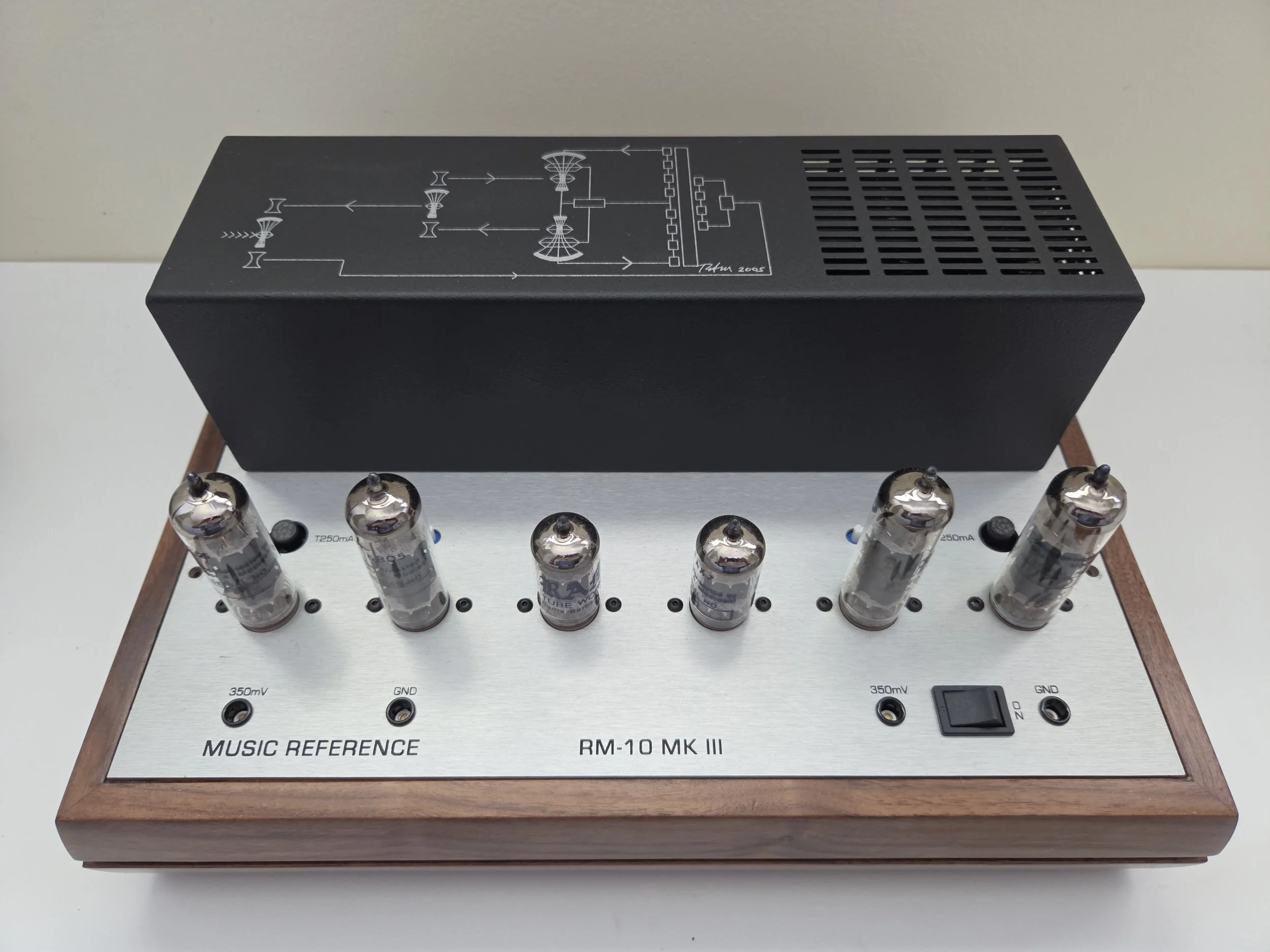
This DIY kit includes all circuit parts (excluding tubes), printed circuit board, hardware, top and bottom plates, transformer cover (the original while they last), frame, and transformers. A basic assembly manual will also be provided that includes schematics, a bill of materials, and test data sheet. Please allow 7 to 10 business days after payment for the kit to ship.
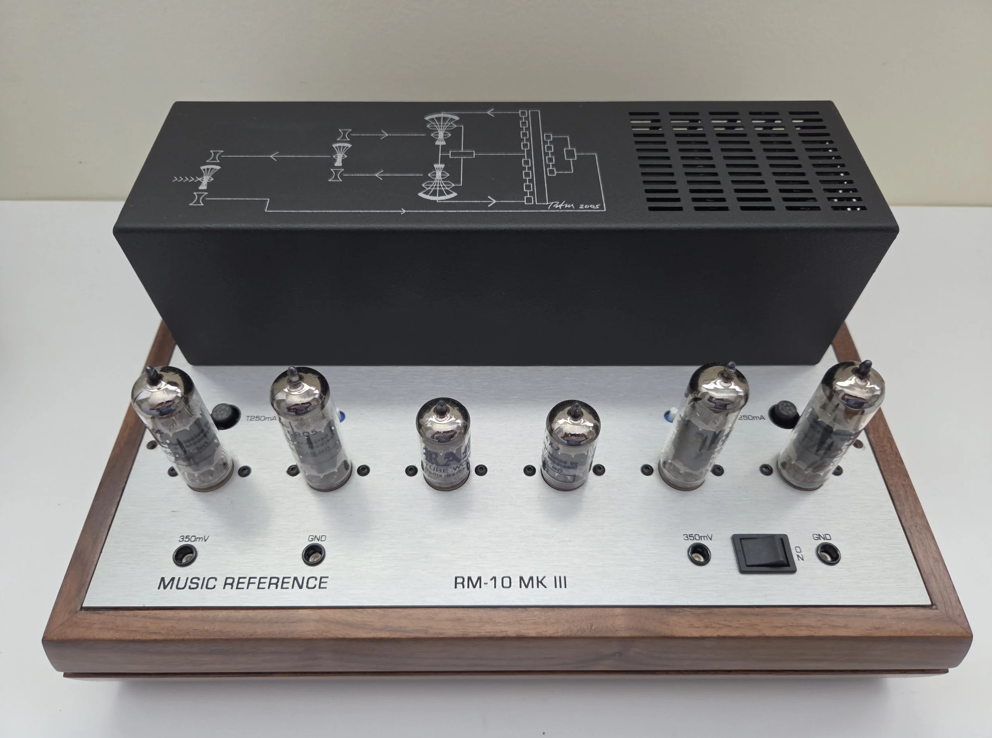
This is a fully built amplifier using the same parts as the DIY kit. Includes a 1 year non-transferable warranty against manufacture defects.
Tube set is listed here for informational purposes only and not sold individually. It is only available with the purchase of an RM-10 MK III Kit or fully built stereo amplifier. When selecting either RM-10 MK III product you will be given the option to add the tube set to the order. Tube set includes 4 x Ei 6BQ5/EL-84 and 2 × RAM Super Low Noise 12AX7.
Genesis of the RM-10 MK III
Some of you may be curious as to how the concept of a MkIII version of the RM-10 amplifier came about. Well it all started in the Fall of 2018 when Roger first learned of his cancer diagnosis. I was shocked to say the least and after a few weeks we spoke about Roger’s goals for the transition of the company. He was adamant that it should continue and wanted me and a couple of his other friends I knew to take it over upon his death. In the meantime, Roger had decided that there would be two projects he would like to finish before the disease prevented him from working. The first project was an evolution of the Music Reference OTL-1 output transformer less amplifier to be based on Julius Futterman’s H-3A circuit. Roger was making significant improvements to the circuit and produced a working pair of monoblocks but could not complete the project as the disease had finally taken a physical toll on him.
However, Roger’s mind was still sharp and so we set out to plan the second project which was the Music Reference RM-10 MkIII. When Roger moved up to the Bay Area from Santa Barbara in 2014 one of his goals was to focus on teaching and developing audio education programs. So, he founded the Berkeley Hi-Fi School and began tutoring students, some of whom became interns and worked on some projects with us. In addition, he wanted to start formal DIY classes along the lines of the Randall Museum where students could build their own components as part of a curriculum of courses. Roger felt the RM-10 MkIII would be the perfect amplifier for the first class. Once Roger thought this it through he and I discussed the design philosophy and what needed to be done to bring the project to life.
I cannot say the process of working with Roger at this stage of his disease was easy. While his mind was sharp, he tired easily and was in significant pain. It made discussing concepts much harder than it was previously before the disease took hold of him. So, when he told me that one of the first design changes for the amplifier was that the circuit would be laid out on a printed circuit board (PCB), I was not entirely happy. It wasn’t that Roger had never used PCBs in his designs before so much as it was the RM-10 had a reputation of being an easy to build, reliable, and if needed serviceable point-to-point wired amplifier. However, Roger felt that today’s PCBs were of much higher quality than when the original RM-10 debuted and he could lay out the circuit such that it would still be easy to build, reliable, and serviceable. In my experience I knew where to cut my losses with Roger so there was not much pushback from me.
The other aspect of the design Roger changed was that this would only be a stereo amplifier and not be switchable to monaural operation. This design change really ruffled my feathers, and we debated on this decision for quite some time. Unlike the PCB decision this one was not related to anything having to do with difficulty building, reliability, or serviceability. In the latter part of his career Roger started trending towards building low power amplifiers. One they were easier to design (at least for Roger), two they were lighter, and three they were lower in distortion. Roger often mentioned that audiophiles should buy a power meter to really understand how many watts they were using to listen to music. Other than musical peaks less than a couple watts were needed to get optimal sound pressure level (SPL). Factor in the low distortion and the amplifier not having to work so hard to produce adequate volume and you have a recipe for great sound. At this time Roger was also using tone bursts to measure his amplifiers, and he noted that even though an amplifier design might yield 8 or so watts, if designed properly it would be capable of handling 20 watt peaks. In the end after a long debate Roger quite loudly said, “35 watts ought to be enough for anybody.” End of discussion.
Unfortunately, Roger passed away before we could really get started on the project, so it was up to the rest of us to make the RM-10kIII a reality. We enlisted the help of Scott Frankland the owner of Scott Frankland & Associates to be the lead engineer and develop the layout for the PCB. Scott is very familiar with Roger’s designs and was instrumental in helping us not only with the PCB, but the top plate layout as well. We used Roger’s philosophy for parts selection, and we were able to get the transformers wound to original spec by a third party vendor. Neal Rasmussen at Neal Faye Designs who Roger worked with in the past was kind enough to make the top plates for us. The only other area where we diverged from the original design was the wood frame which we beefed up a bit versus the frame used on the RM-10 MkII. As the original RM-10 was the first circuit design to achieve 35 watts from a pair of EL-84/6BQ5 tubes, the core design philosophy remains intact. For reference you can read about it here in the manual’s Design Philosophy section.
When it came to determining the price of the what a fully built RM-10 MkIII should cost it would be worth noting that Roger lamented at how high the cost of the RM-10 MkII reached over the years. Even though we were able to justify the cost Roger was still not convinced it should be that high. I do not know if it was the disease or if Roger was a bit out of touch with the times, but it was his goal for the cost of a fully built amplifier to be sub $2,000. As we were progressing through the project and experiencing delays, including a lengthy one during Covid, as well as added costs it became clear that we could not meet that goal. Given that the Berkeley Hi-Fi School would no longer exist it became evident that we could compromise and offer fully built amplifiers at $2,800 and kits for the DIY crowd at $1,650. So, nearly seven years in the making the RM-10 MkIII has become a reality. We have been somewhat slow to go to market but are now selling kits and fully built amplifiers. Hopefully with some added market exposure we can sell some more and make Roger proud and some customers happy.
Music Reference RM-10 MK III
RAM Tubes is pleased to announce on the 6th anniversary of Roger’s passing that a select number of RM-10 MkIII kits are available for purchase. The build level is rated as difficult, and you should consider yourself to have advanced DIY skills and knowledge of audio electronics concepts and circuits, as well as the proper equipment to do the job. Note that RAM Tubes will not provide support for the DIY build.